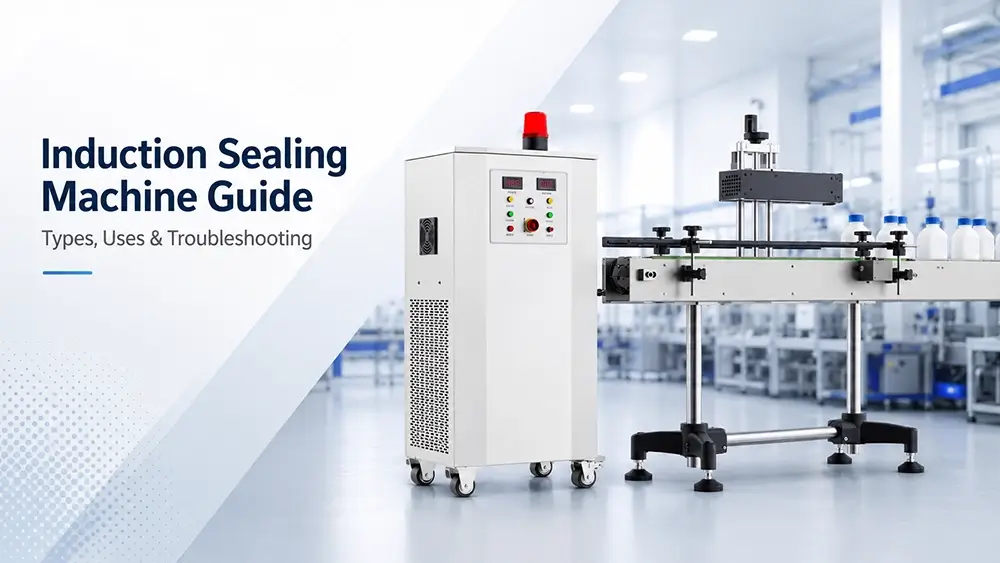
Introduction
When customers pick up a bottle of medicine, juice, sauce, cosmetic serum, or chemical liquid, the first thing they notice is not only the label or the bottle shape. They also care whether the package feels clean, safe, and properly sealed. A loose cap or a leaking bottle can damage the product, affect brand trust, and create serious problems during shipping.
That is why an induction sealing machine has become a common choice for many manufacturers. It helps create a strong aluminum foil seal on the bottle mouth without direct contact. The result is a clean, reliable, and professional seal that helps protect the product inside.
For food, pharmaceutical, cosmetic, daily chemical, and chemical products, sealing is not just the final step of packaging. It is an important part of product safety, shelf life, and customer experience. In this guide, we will look at what an induction sealing machine is, how it works, where it is used, what types are available, and how to solve common sealing problems.
What Is an Induction Sealing Machine and What Is It Used For?
What Is an Induction Sealing Machine?
A sealing machine is a piece of equipment used to seal packaging containers such as bottles, jars, and cans. An induction sealing machine is specially designed to seal bottles with aluminum foil liners by using electromagnetic induction heating.
Unlike traditional contact sealing, the induction head does not press directly onto the bottle mouth. Instead, it generates a high-frequency electromagnetic field. This field heats the aluminum foil liner inside the cap, melts the sealing layer, and bonds the foil to the bottle mouth.
This makes the sealing process clean, fast, and consistent. It is especially useful for bottled products that require leak prevention, freshness protection, and tamper evidence.
Main Uses of Induction Sealing
An induction sealing machine is mainly used to improve the safety, stability, and appearance of bottled products.
First, it helps keep the contents fresh. A proper aluminum foil seal can reduce the entry of air, moisture, dust, and microorganisms. This is very important for food, medicine, health supplements, and other products that need a longer shelf life.
Second, it helps prevent leakage. Liquids, powders, sauces, oils, and chemical products can easily spill during transportation if the bottle is not sealed well. Induction sealing adds an extra protective layer between the cap and the product.
Third, it provides better safety protection. Many aluminum foil seals are used as tamper-evident seals. Once the seal is broken, customers can clearly see that the product has been opened before.
Finally, it improves the overall packaging appearance. A flat and firm foil seal makes the product look more professional, more reliable, and more suitable for retail or export markets.
Key Advantages of Aluminum Foil Induction Sealing
Non-Contact Sealing
One of the biggest advantages of an induction sealing machine is non-contact sealing. The induction head does not touch the bottle mouth directly. This helps reduce mechanical wear and avoids unnecessary contact with the product package.
For industries such as food, pharmaceuticals, and cosmetics, hygiene is always a major concern. A non-contact sealing process can help reduce contamination risk and keep the packaging process cleaner. It is also easier to maintain stable sealing quality over long production runs.
This is one reason many manufacturers prefer induction sealing for products with strict hygiene requirements.
Excellent Sealing Performance
The aluminum foil liner plays a key role in the sealing result. A good foil liner can help block oxygen, light, moisture, and outside contaminants. This is very useful for products that are sensitive to air, humidity, or storage conditions.
For example, sauces, juices, oral liquids, tablets, powders, creams, and chemical liquids all need stable packaging. A good seal helps protect the product’s flavor, active ingredients, texture, or chemical stability.
In simple words, a reliable induction sealing machine helps the product stay in better condition from the factory to the customer.
Fast and Efficient Sealing
Induction sealing uses instant heating. When the bottle passes under the induction head, the aluminum foil liner heats up quickly and bonds to the bottle mouth in a very short time.
This fast heating method improves production efficiency and helps maintain consistent sealing quality. For automatic production lines, the induction sealing machine can be connected with filling machines, capping machines, labeling machines, and other packaging equipment.
That makes it suitable not only for small workshops, but also for medium and large-scale production.
How an Induction Sealing Machine Works
Working Principle
The working principle of an induction sealing machine is simple to understand. After the bottle is filled and capped, it passes under the induction sealing head. The machine sends high-frequency current to the induction head, creating an electromagnetic field.
The aluminum foil liner inside the cap reacts to this electromagnetic field and heats up quickly. As the foil reaches the required temperature, the heat-sealing layer on the foil melts. Then it bonds tightly to the bottle mouth.

After cooling, the foil forms a firm seal. This seal helps prevent leakage, protect the product, and extend shelf life.
Working Principle Diagram

Main Types of Induction Sealing Machines
Different production needs require different sealing equipment. Some customers only need a simple handheld model for small batches, while others need an automatic induction sealing machine for continuous production lines. Below are the common types.
Handheld Induction Sealing Machine
A handheld induction sealing machine is suitable for small-batch production, laboratory use, sample testing, or startup factories. It is easy to operate and does not require a large production space.

For detailed specifications, please visit:
https://xuefill.com/product/hand-held-induction-sealing-machine/
Desktop Induction Sealing Machine
A desktop model is more stable than a handheld model and is suitable for small to medium production. It is often used by food, cosmetic, healthcare, and daily chemical manufacturers that need better consistency but do not need a full automatic line yet.

For detailed specifications, please visit:
https://xuefill.com/product/band-sealer-machine/
Air-Cooled Induction Sealing Machine
An air-cooled induction sealing machine is commonly used for continuous production. It uses air cooling to control the temperature of the induction system. This type is easy to maintain and suitable for many standard bottle sealing applications.
Split-type model

For detailed specifications, please visit: https://xuefill.com/product/induction-sealer-machine-sf-2100/
Integrated model

For detailed specifications, please visit: https://xuefill.com/product/induction-sealing-machine-sf-2300/
Water-Cooled Induction Sealing Machine
A water-cooled induction sealing machine is designed for higher intensity production. It uses water circulation to provide stronger cooling performance, making it suitable for long-time operation or higher-power sealing needs.
Split-type model

For detailed specifications, please visit: https://xuefill.com/product/automatic-sealing-machine-sf-3000/
Integrated model
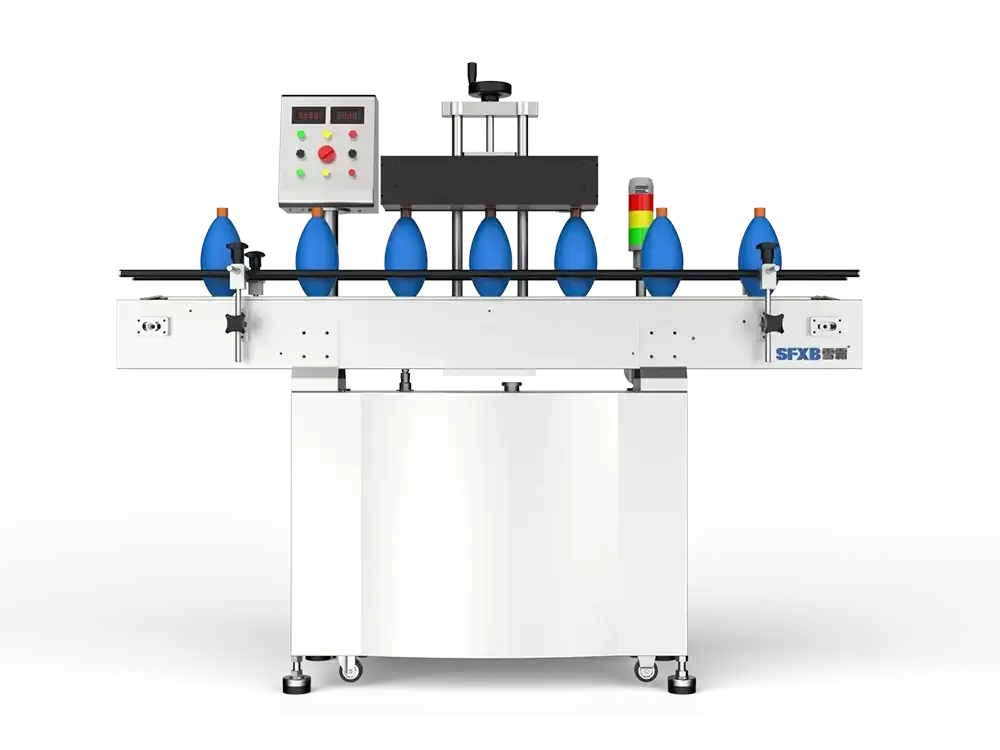
For detailed specifications, please visit: https://xuefill.com/product/auto-sealing-machine-sf-2900/
Air-Cooled vs Water-Cooled Induction Sealing Machines
Air-cooled and water-cooled models are both widely used, but they are designed for different working conditions.
An air-cooled induction sealing machine is usually easier to install and maintain. It is suitable for normal production speeds, standard bottle sizes, and general sealing requirements. For many small and medium factories, air-cooled models are already enough.
A water-cooled model offers stronger cooling performance. It is more suitable for high-speed lines, long working hours, larger bottle mouths, or products that require higher sealing power. The cooling system helps keep the machine stable during continuous operation.
In short, choose air-cooled if your production is moderate and easy to manage. Choose water-cooled if your line runs for long hours or needs stronger sealing performance.
Wide Compatibility of Induction Sealing Machines
Suitable for Different Containers
An induction sealing machine can be used with many types of containers, including plastic bottles, glass bottles, and some compatible metal containers. It is commonly used for round bottles, square bottles, jars, and other packaging formats.
However, the sealing result depends on the bottle material, bottle mouth quality, cap type, and aluminum foil liner. The foil liner must match the bottle material. For example, PE, PET, PP, and glass bottles may require different liner structures.
Before choosing a machine, it is better to test your actual bottle, cap, and foil liner together. This helps confirm the best power, speed, and sealing distance.
Suitable for Different Industries
The induction sealing machine is widely used in food and beverage, pharmaceuticals, healthcare products, cosmetics, daily chemicals, and chemical products. Each industry has different packaging needs, but the purpose is usually the same: better sealing, better protection, and better product presentation.
Here is a simple overview:
| Industry | Common Products | Main Packaging Needs | How Induction Sealing Helps |
|---|---|---|---|
| Food & Beverage | Sauces, juice, yogurt, mayonnaise, oil | Freshness, hygiene, and leakage prevention | Helps extend shelf life and reduce leakage |
| Pharmaceutical & Healthcare | Oral liquids, tablets, powders, supplements | Safety, tamper evidence, stability | Provides a clean and secure foil seal |
| Cosmetics & Daily Chemicals | Serum, cream, shampoo, lotion | Appearance, leakage prevention, product protection | Improves packaging quality and customer trust |
| Chemical Products | Solvents, reagents, industrial liquids | Leakage prevention, safety, and volatility control | Helps reduce leakage and evaporation risk |
Suitable for Special Production Conditions
Some products are sensitive to heat, moisture, air, or contamination. For these products, an induction sealing machine can provide a strong protective seal without directly touching the bottle mouth.
This makes it useful for products that need cleaner packaging or safer transportation. It also works well with automatic packaging lines where stable output and repeatable sealing quality are important.
The key is not only the machine itself. The bottle, cap, foil liner, and machine settings must work together.
Industry Applications of Induction Sealing Machines
Pharmaceutical and Healthcare Industry
The pharmaceutical and healthcare industry has high requirements for packaging safety and sealing reliability. Products such as medicines, supplements, oral liquids, powders, and medical-related products need secure packaging during storage and transportation.
An induction sealing machine helps create a tamper-evident and leak-resistant seal. This can improve product safety and reduce the risk of contamination.
For pharmaceutical packaging, sealing quality is not just about appearance. It is directly related to product protection and user confidence.
Cosmetics and Daily Chemical Industry
Cosmetics and daily chemical products often need both good sealing and attractive packaging. Products such as serums, essential oils, sunscreen, toothpaste, shampoo, shower gel, and lotion must be sealed properly to avoid leakage.
A clean aluminum foil seal gives the package a more professional look. It also helps protect the product from air and moisture before the customer opens it.
For brands selling through retail, e-commerce, or export channels, a good seal can reduce complaints and improve the customer experience.
Food and Beverage Industry
In the food and beverage industry, sealing is closely related to freshness and hygiene. Products such as mayonnaise, Greek yogurt, peanut butter, sauces, juice, drinks, and edible oils often require reliable sealing.
An induction sealing machine can help prevent leakage and reduce the risk of outside contamination. It also helps protect flavor, texture, and shelf life.
For food manufacturers, a poor seal can lead to product loss, customer complaints, and shipping problems. A stable sealing process is a small step, but it makes a big difference.
Chemical Industry
Chemical products may be corrosive, volatile, or sensitive to leakage. That makes packaging safety especially important.
An induction sealing machine can provide a reliable seal for many chemical bottles and containers. It helps reduce leakage during storage and transportation and improves packaging safety.
For chemical manufacturers, sealing quality is also related to environmental protection and workplace safety. A strong foil seal adds another layer of protection.
Common Induction Sealing Problems and Solutions
Even with a good induction sealing machine, sealing problems can still happen if the bottle, cap, foil liner, or machine settings are not suitable. The table below can help you quickly identify common problems and possible solutions.
| No. | Problem | Possible Causes | Suggested Solutions |
|---|---|---|---|
| 1 | Weak seal or no seal | Power too low; induction head too far from bottle mouth; bottle mouth has burrs or dirt; foil liner does not match bottle material | Increase power or reduce conveyor speed; adjust induction head height; clean bottle mouth; use matching foil liner |
| 2 | False seal, easy to peel off | Heating time too short; conveyor speed too fast; power too low | Slow down conveyor speed; increase power; extend heating time |
| 3 | Over-sealing, bottle mouth melting, or smoking | Power too high; conveyor speed too slow; foil liner has poor heat resistance | Reduce power or increase conveyor speed; use better heat-resistant foil liner |
| 4 | Uneven seal, one side sealed and one side not sealed | The bottle is tilted; the induction head is not centered | Adjust conveyor guide rails; correct induction head position |
| 5 | Foil bulging or falling off | The adhesive layer quality is poor or damp; the sealed bottle is pressed too soon | Use a better foil liner; allow more cooling time before pressure |
| 6 | Machine overheating or alarm shutdown | Cooling fan not working or blocked; high room temperature; continuous overload operation | Check fan and cooling channels; improve ventilation; allow the machine to rest when needed |
| 7 | Conveyor belt deviation or shaking | Belt is loose or unevenly tensioned; bottle is too heavy or unstable | Adjust belt tension; keep bottles stable on the conveyor |
| 8 | Induction head not working or unstable power | Induction head damage, wrong position, and aging of the power module | Check head connection; adjust height and angle; replace power module if needed |
| 9 | Foil liner damaged or wrinkled | Foil liner stored improperly or damp; the liner does not match the bottle mouth | Store foil liners in a dry place; use matching liners |
| 10 | Cap deformation or yellowing | Power too high or heating time too long; the cap material has poor heat resistance | Lower power or increase speed; use heat-resistant caps |
Most sealing problems can be solved by adjusting power, conveyor speed, induction head height, and liner selection. If the same problem keeps happening, it is better to test the complete packaging set: bottle, cap, foil liner, and product.
How to Choose the Right Induction Sealing Machine
Choosing the right induction sealing machine is not only about price or machine size. It should match your bottle, cap, liner, product type, and production capacity.
For small batches or laboratory testing, a handheld or desktop model may be enough. For continuous production, an air- or water-cooled automatic model is usually more suitable.
You should also consider bottle mouth diameter, conveyor speed, production environment, and daily working hours. If the machine is connected with a filling line, the sealing speed should match the output of the filling and capping machines.
The best choice is always based on real production conditions. If you are not sure which model fits your product, you can send your bottle size, cap type, foil liner information, product details, and required capacity to XUEFILL. Our team can help recommend a suitable sealing solution.
Final Thoughts
A reliable induction sealing machine can do much more than close a bottle. It helps protect the product, reduce leakage, improve shelf life, and give customers more confidence in your brand.
Whether you are packaging medicine, supplements, sauces, beverages, cosmetics, daily chemical products, or chemical liquids, choosing the right machine and foil liner is important. The machine, bottle, cap, and liner must work together to achieve a stable seal.
If you are looking for an induction sealing machine for your production line, XUEFILL can help you choose a suitable model based on your product, bottle size, cap type, sealing requirement, and production capacity.