Introduction
In the past month, global attention has increasingly focused on the oil market, as crude oil prices continue to surge due to geopolitical tensions, supply chain disruptions, and shifting energy policies.
However, the impact of rising oil prices extends far beyond the energy sector. Petroleum is the foundation of countless downstream products, including chemicals, cosmetics, pharmaceuticals, lubricants, and packaging materials—many of which require precise filling processes during production.
As the cost of petroleum-derived raw materials increases, manufacturers are facing growing pressure to reduce waste, improve efficiency, and ensure higher accuracy in their production lines. Even small filling errors can lead to significant cost losses at scale.
This is where filling machines and filling pumps play a critical role. From low-viscosity liquids to high-viscosity or semi-solid materials, different pump technologies are essential to ensure stable, accurate, and hygienic filling. Among various industrial pump types, ceramic pumps are widely used in corrosive and high-wear environments, making them an ideal solution for demanding industrial applications.
In this guide, we will explore 7 types of filling pumps, their working principles, and how to choose the right solution for your application in today’s increasingly demanding manufacturing environment
In a volatile global market, choosing the right filling technology is no longer just a technical decision—it is a strategic advantage.
What is a filling pump?
Filling pumps are critical equipment in automated production lines, designed to precisely and efficiently inject liquids, pastes, or small particle products into containers.
It guarantees a high degree of consistency in each fill volume and avoids dripping and splashing. The core principle is that the power drive (electric, pneumatic, etc.) generates suction and pressure, and controls the quantitative conveying of materials through pipelines and valves.
According to material characteristics (such as viscosity, hygiene requirements) and production capacity requirements, it is mainly divided into peristaltic pumps, gear pumps, plunger pumps, rotary piston pumps, and other types, which are widely used in beverage, food, daily chemical, pharmaceutical, and other industries, and are the core of achieving efficient and precise filling.
Why Pump Selection Matters in Filling Machines?
Filling different liquids requires different filling processes
★Low viscosity liquids require speed and precision
★High viscosity materials require a strong conveying capacity
★Hygienic liquids require aseptic filling and prevent cross-contamination
★Liquids containing particles should be prevented from jamming the pump
Choosing the wrong pump can lead to leakage, inaccuracy, or product damage.
7 Types of Filling Pumps and How They Work
1. Piston Pump

A piston pump is equipped with check valves at both the inlet and outlet. These check valves allow fluid to flow in only one direction, preventing backflow. When the piston moves upward, a negative pressure is created inside the chamber.

At this time, the inlet check valve opens, allowing fluid to enter through the inlet.
When the piston moves downward, the pressure inside the chamber increases, which pushes the fluid out of the cylinder through the outlet.

2. Plunger Pump
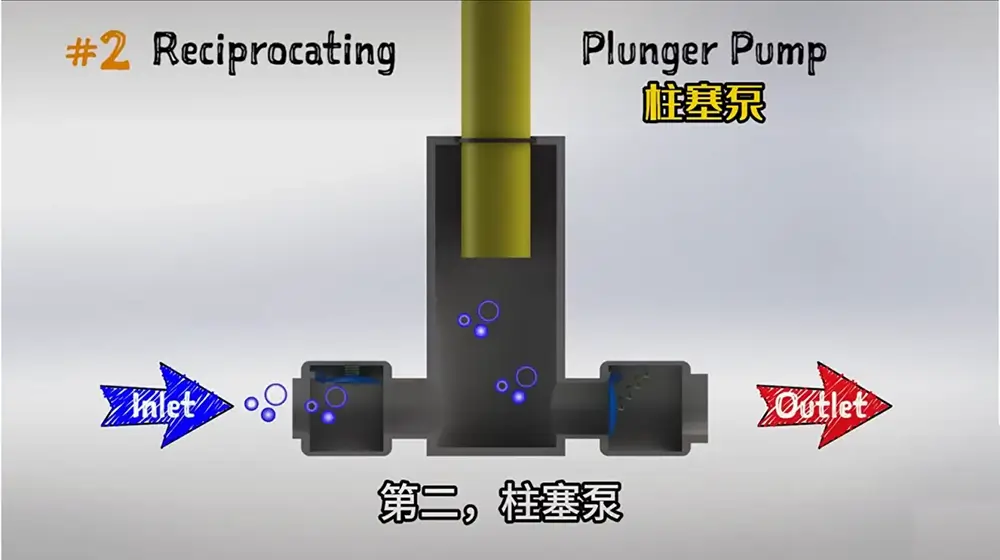
A plunger pump looks very similar to a piston pump, but they operate slightly differently.
In a piston pump, the piston fits tightly against the cylinder wall, while in a plunger pump, the plunger does not need to tightly seal against the cylinder.
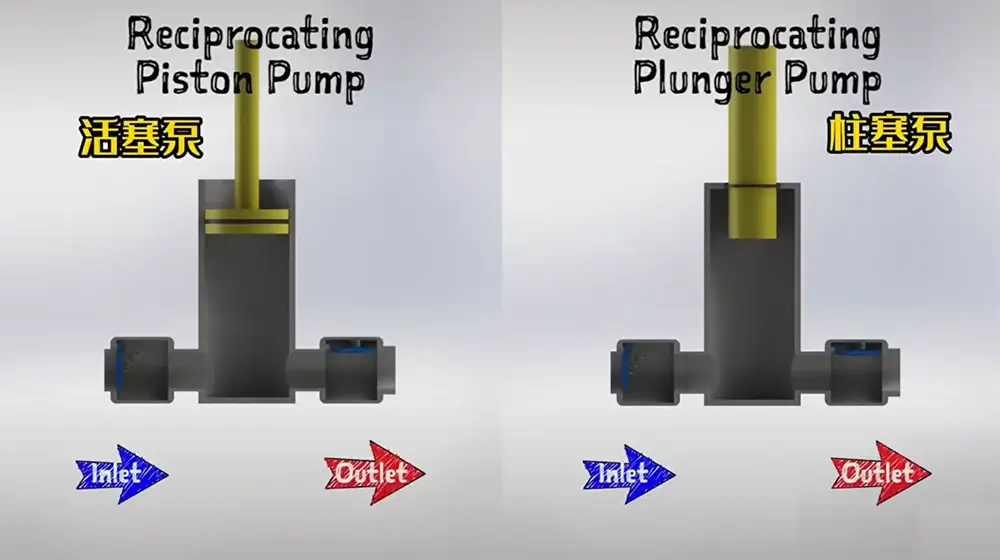
volume of the sealed working chamber, thereby achieving suction and discharge of fluid.
Because the plunger pump does not rely on a tightly sealed piston, it generally has stronger conveying capacity and is more suitable for transporting high-viscosity liquids.
3. Diaphragm Pump
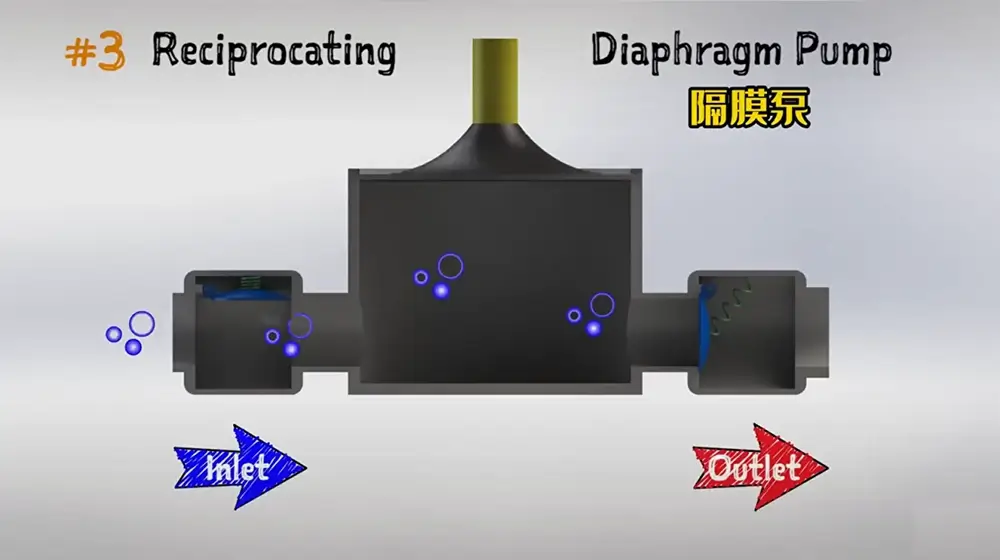
A diaphragm pump changes the volume of the chamber by flexing a diaphragm located above the chamber.
This deformation allows fluid to be drawn in and pushed out. Since the diaphragm isolates the fluid from the driving components, this design ensures that the fluid will not leak and provides a high level of safety and cleanliness.
4. Gear Pump
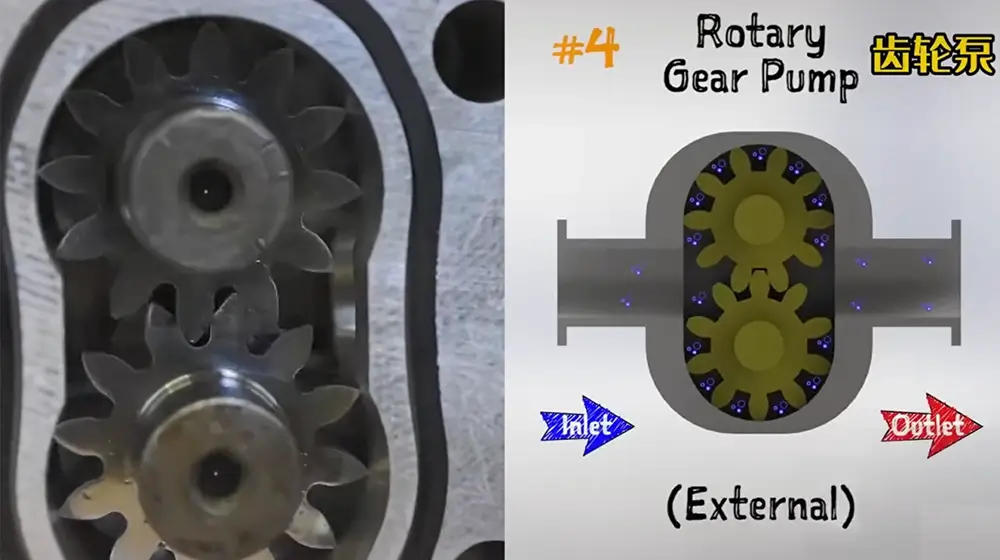
A gear pump consists of two rotating gears.
The meshing of the gears forms a continuously changing sealed chamber, including a suction chamber and a discharge chamber.
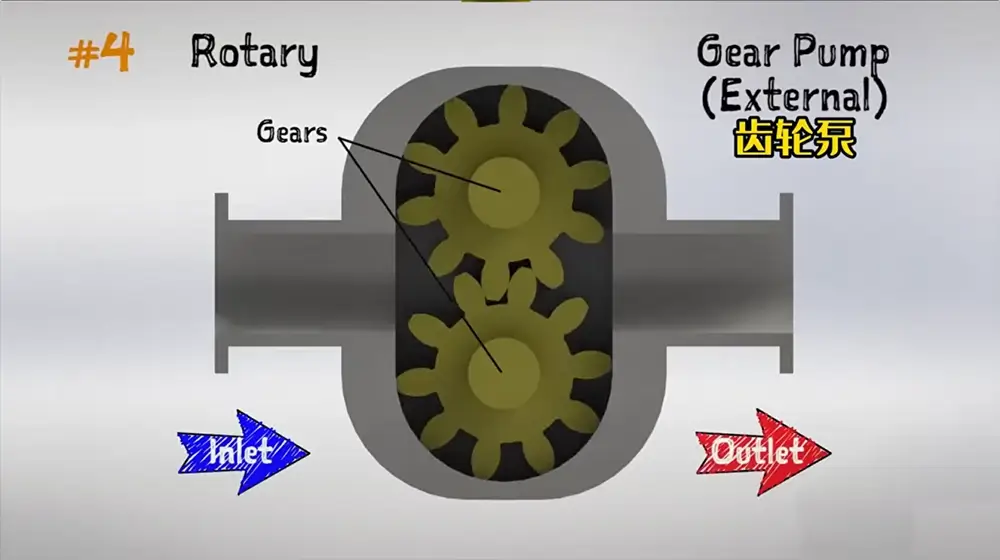
As the gears rotate, the volume of the suction chamber gradually increases, creating a localized vacuum that draws liquid in.
Meanwhile, the volume of the discharge chamber decreases, creating pressure that forces the liquid out.
5. Lobe Pump
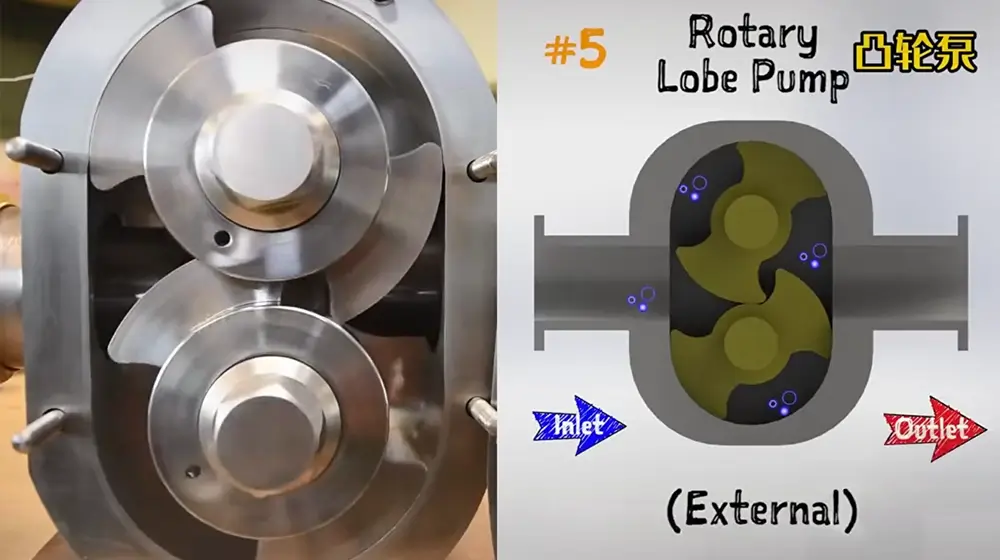
A lobe pump has rotors with two or more lobes.
When one lobe rotates toward the center of the housing, a moving chamber is formed between the outer surface of the lobe and the inner wall of the elliptical housing.
Another rotor closes the chamber at the outlet, ensuring continuous fluid transfer.
Lobe pumps can adapt to fluids with different viscosities.
6. Peristaltic Pump
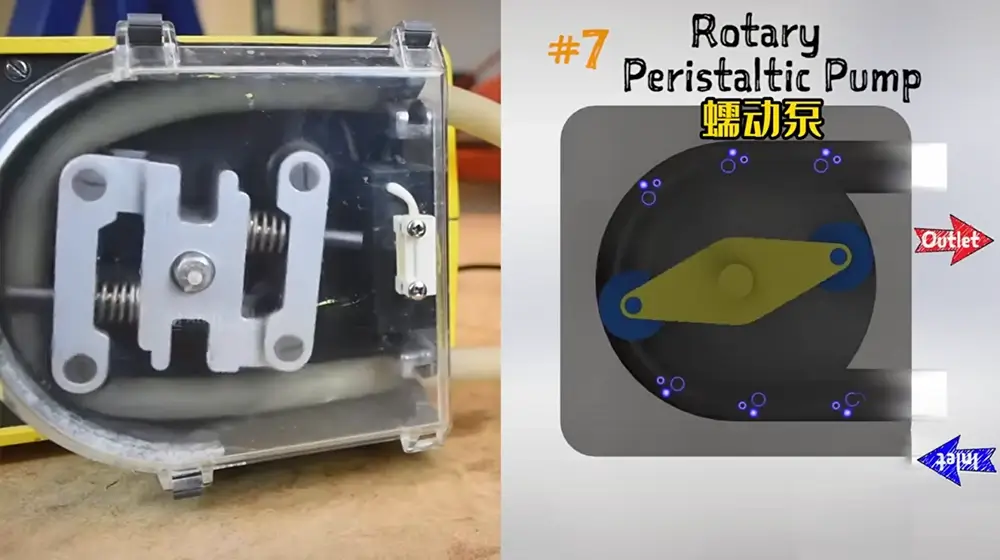
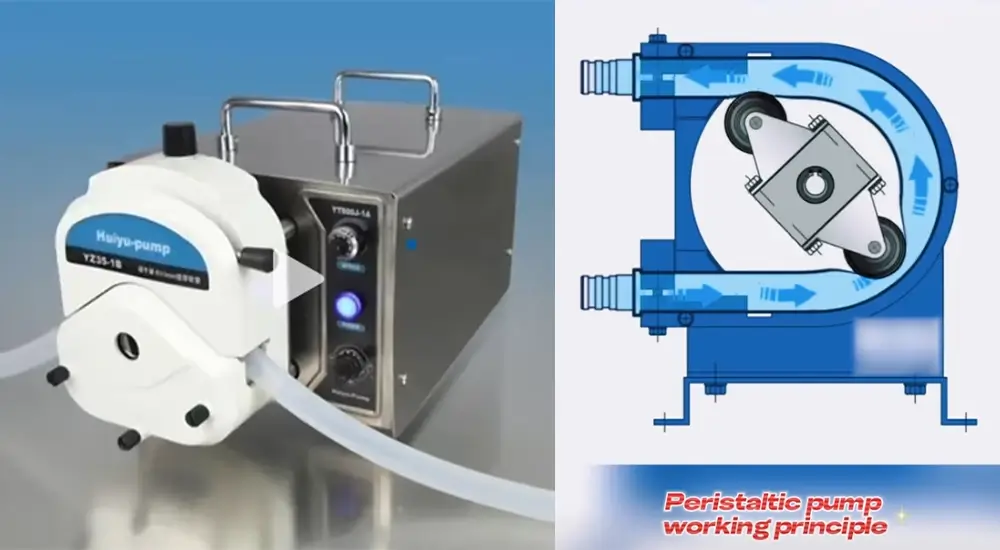
When rollers rotate around the tube, the tube is compressed between the rollers and the housing wall, which continuously pushes the fluid forward.
Similar to diaphragm pumps, the moving parts of a peristaltic pump do not come into contact with the fluid.
Therefore, they are especially suitable for applications that require high hygiene standards, such as the medical, food, and chemical industries.
7. Screw Pump
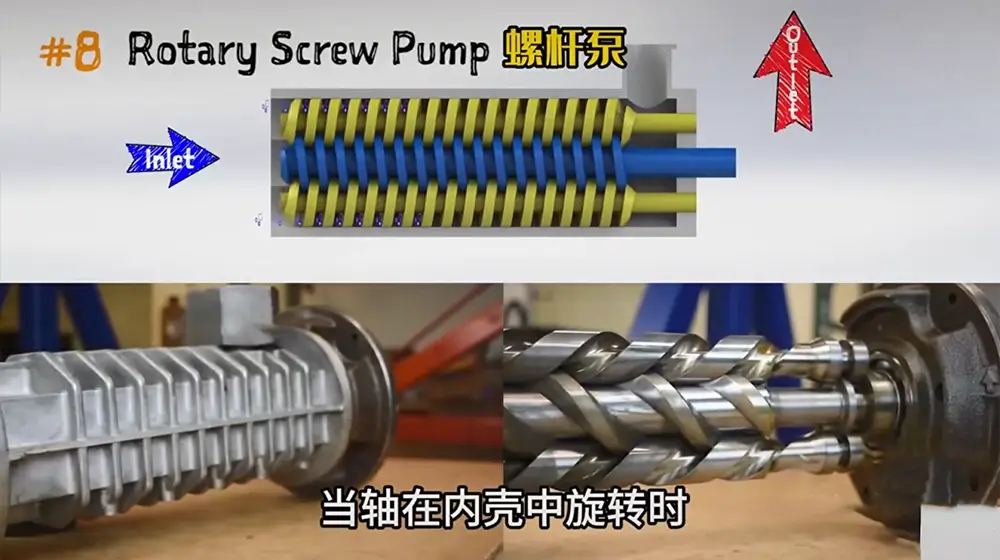
A screw pump is driven by one or more screws.
As the shaft rotates within the housing, fluid is trapped in the gaps between the screw threads and is transported along the screw.
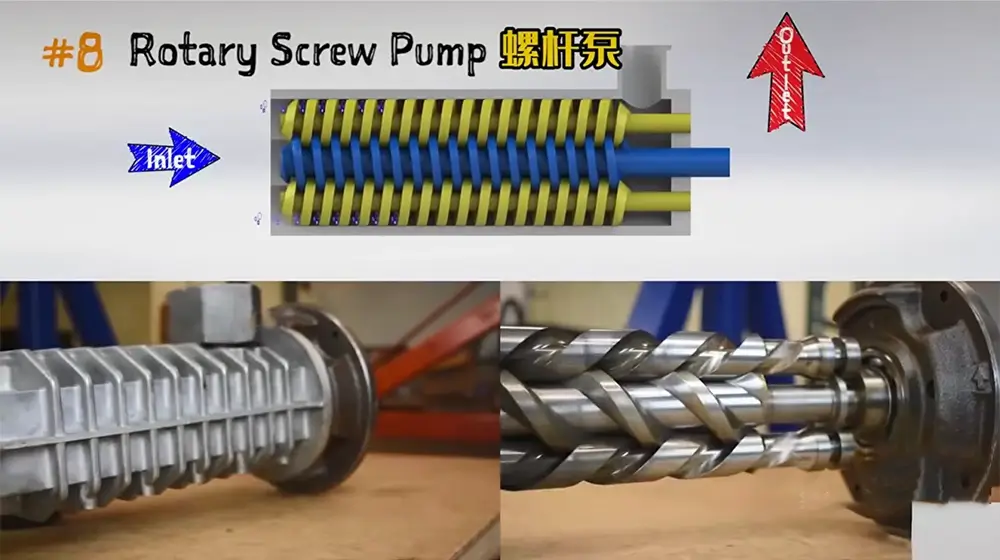
Eventually, the fluid is discharged from the outlet chamber.
Screw pumps have strong conveying capacity and are suitable for transporting high-viscosity fluids, as well as media containing solid particles or fibers.
Flowability Comparison (Quick Guide)
- Low viscosity (water-like): peristaltic, gear pump
- Medium viscosity (oil, lotion): piston, diaphragm
- High viscosity (cream, paste): plunger, lobe pump, screw pump
- With particles/fibers: screw pump
In short, the higher the viscosity, the stronger the pump displacement capability required.
Applications by Industry
Ceramic Pump


1. Introduction to the Ceramic Pump
Ceramic pumps are extremely precise filling devices.
The majority of ceramic pumps are ceramic piston pumps, in which the ceramic rod fits closely and smoothly within the pump chamber. This design ensures that ceramic pumps boast high precision and cleanliness.
- The highest hygiene and health standards in the biopharmaceutical, food, and cosmetic industries.
- Extremely inert chemical stability, acid and alkali resistance, corrosion resistance, and high temperature resistance;
- Dense materials have low to zero water absorption.
- High surface finish, minimal friction, so very little material residue;
- The thermal expansion coefficient is very small, the piston clearance matches more, the filling precision is very high, and it can realize online cleaning and sterilization.
- Super hard, wear resistance, minimal particle release, and long service life. It is used in the biopharmaceutical, chemical, electronics, energy, and daily chemical industries, usually for more expensive or corrosive materials.
2. Attention
Currently, the countries in the world that produce ceramic pumps include China, Germany, Japan, and Denmark.
The English name “China” is indeed closely associated with porcelain, and China also boasts the longest, most continuous, and most influential history of ceramic craftsmanship in the world.
With its strong manufacturing infrastructure, especially in the field of ceramic production, China is able to produce ceramic pumps of superior quality at competitive prices, thus leading the world in this industry.
However, ceramic pumps also have their drawbacks—they are prone to breaking. Although they are not as fragile as glass, they can still be easily damaged if dropped from a height onto a hard surface.
3. Application fields
It is used in the biopharmaceutical, chemical, electronics, energy, and daily chemical industries, usually for more expensive or corrosive materials.
Peristaltic Pump
1. Introduction to peristaltic pumps
A peristaltic pump is a positive displacement pump that transfers fluid by circulating an elastic hose through rollers. The fluid only touches the inner wall of the hose throughout the process, and other parts of the pump body do not come into contact with the medium, which realizes the isolation and sealing of transportation.
2. Advantages and disadvantages
Advantages: clean and pollution-free, easy to clean or replace hoses; High accuracy, suitable for measurement; Low shear force to protect sensitive fluids; It can transport high-viscosity, particulate, and corrosive media; It has self-priming ability and can be rotated.
Disadvantages: The hose is a consumable and needs to be replaced regularly; Pulsation in the output; The working pressure is relatively low; The efficiency and economy are average when the flow rate is high.
3. Application fields
It is widely used in pharmaceutical, bioengineering (such as cell fluid delivery), food and beverage (if sauce filling), chemical environmental protection (corrosive liquids, water treatment dosing), laboratory analysis, and general industrial fields.
Tips: Many users overlook that peristaltic pump silicone tubes are consumables; over time, reduced elasticity leads to lower accuracy.
Gear Pump

Gear pumps are a type of positive displacement pump that operate through the meshing of a pair of gears within a pump casing. They function by trapping fluid between the gear teeth and the pump housing, transporting it from the inlet to the outlet. Gear pumps are compact, robust, and known for their reliable performance in various industrial applications.
1. Hydraulic Systems
As a primary power source in hydraulic systems, gear pumps are essential for:
- Construction machinery (excavators, loaders, cranes)
- Machine tools (injection molding machines, die-casting equipment)
- Automotive systems (power steering, transmission, and lubrication)
- Aerospace (aircraft hydraulic systems)
2. Fuel Transfer Systems
- Automotive fuel delivery systems
- Marine fuel transfer applications
- Fuel dispensing at gas stations
- Aviation refueling equipment
3. Lubrication Systems
- Centralized lubrication systems for industrial machinery
- Lubrication in turbines and compressors
- Circulating oil in power generation units
- Lubrication for heavy-duty gearboxes
4. Chemical & Process Industries
- Transfer of resins, paints, and adhesives
- Handling basic chemical raw materials
- Processing high-viscosity fluids (e.g., asphalt, polymers)
- Metering and dosing systems
5. Specialized Applications
- Food industry (high-viscosity products like chocolate and syrups)
- Pharmaceutical industry (creams, emulsions, and ointments)
- Printing machinery (ink circulation systems)
- Military equipment (hydraulic systems in armored vehicles)
How to Choose the Right Filling Pump
When selecting a pump, consider:
1. Liquid viscosity
Highly fluid liquids, just like water, are usually filled using gear pumps. However, these liquids must contain no particles, as such particles can cause rapid wear and tear on the gear pump. As a result, a brand-new gear pump may become unusable within a very short period of time.
For high-viscosity liquids, piston pumps are usually used. When filling such liquids, piston pumps generally achieve a higher production rate than when filling water, because there is no need to worry about liquid splashing. The piston can move quickly, allowing for efficient filling. However, if water is filled too quickly, it may splash out, which would require reducing the filling speed. Additionally, piston pumps can handle the presence of certain particles in the liquid.
Rotary pumps are the most versatile; they can be used to fill liquids, substances containing particles, as well as sauces and other materials.
2. Filling accuracy requirements
Generally speaking, ceramic pumps have the highest filling accuracy, capable of achieving levels as low as 0.2%. This is because the ceramic components inside these pumps are precision-manufactured, with very smooth surfaces that result in minimal friction against the pump chamber, ensuring a tight fit and high accuracy.
Next in accuracy are peristaltic pumps and gear pumps, as well as piston pumps. Their typical accuracy ranges around 2%, but some highly skilled engineers can reduce this to 0.5%. However, the cost of such peristaltic pumps is usually higher than that of ceramic pumps.
Lobe pumps come in third place. Since they are often used for filling substances that contain soft solid particles and whose composition is not homogeneous, it is quite normal for their accuracy to be slightly lower.
Finally, there are screw pumps. These machines are designed for filling rather than precise dispensing, and because their purpose is to quantitatively package solid particles, their accuracy is relatively lower as well.
Tips: Based on our experience with high-precision filling equipment, a larger outlet pipe than the inlet helps ensure stable flow and higher accuracy
3. Hygiene level (food/pharma or not)
Generally , ceramic pumps and peristaltic pumps have the highest hygiene requirements, while others will have lower. Because ceramic pumps and peristaltic pumps are relatively small filling pumps, they are precision instruments; they are mostly used for laboratory filling, which not only ensures accuracy but also ensures hygiene, and at the same time emphasizes this.
Tips: When changing materials, peristaltic pumps only require tube replacement, while other pumps need cleaning—ceramic pumps can withstand strong acid and alkali for stubborn residues.
4. Maintenance and cost
Peristaltic pumps are the easiest to maintain, requiring only periodic silicone tube replacement at low cost.
Ceramic pumps offer high durability and corrosion resistance, but have a higher initial cost; maintenance mainly involves cleaning and occasional seal replacement.
Stainless steel piston pumps require regular seal and piston maintenance, with moderate cost and good durability. Gear pumps have a simple structure but are sensitive to wear and impurities, requiring lubrication and periodic part replacement.
Lobe (rotor) pumps are easy to clean and suitable for hygienic applications, though spare parts are relatively expensive.