Introduction
In real production, an induction sealer is the key to ensuring tight seals, preventing leaks, and stopping tampering. But many operators face common challenges: weak seals, burnt foil, or even no seal at all. On a high-speed line, sealing problems can lead to defective products or even a whole batch leaking, causing costly waste.
To help every operator and manager use an induction sealer correctly and reduce downtime, we’ve created this practical guide. It lists the most common issues with induction sealers and gives you step-by-step solutions — so your packaging runs smoothly, efficiently, and with consistent quality.
Q1: Weak seal or no seal at all — why and how to fix it?
Possible causes:
- Conveying belt speed is too fast, or the induction sealer power is too low — the foil liner doesn’t get heated enough.
- The coil height( induction sealing head ) is incorrect, affecting how the electromagnetic field heats the foil.
- Cap torque is too low — the cap isn’t fully tightened, so the liner doesn’t sit tightly against the bottle mouth.
- Dust or dirt on the bottle mouth prevents the foil from bonding properly.
Solutions:
- Slow down the conveyor speed or increase the induction sealer power.
- Adjust the coil height so it’s at the right distance from the bottle mouth.
- Check and raise the capper’s torque setting — make sure caps are fully tightened.
- Clean the bottle mouth before sealing to remove any debris.
Q2: Overheating — container deforms or foil burns — why and how to fix it?
Possible causes:
- The induction sealer power is set too high.
- The conveying belt speed is too slow, so the foil gets heated for too long.
- Coil height is too low, causing heat to concentrate in one spot.
Solutions:
- Lower the induction sealer output power appropriately.
- Increase the conveyor speed to shorten heating time.
- Raise the coil height slightly to spread heat more evenly.
Tips: Based on our experience, the gap between the induction sealing head and the bottle mouth should generally be set to 5mm — 10mm at most. For large-diameter bottles, increase the distance a bit. Why? The magnetic field from the sealing head works like a beam of light. If you place it too close, all the energy hits the center of the bottle mouth — the middle gets burnt while the edges stay cold.
So raise the induction sealing head a little. This lets the magnetic field spread evenly, heating the whole bottle mouth uniformly. That gives you a strong, clean seal every time.
Q3: After sealing, the foil liner sticks to the cap instead of the bottle mouth — why and how to fix it?
Possible causes:
- Overheating (power too high or line speed too slow)
- The cap is screwed on too tightly.
- The liner material is not compatible with the cap — too much adhesion.
Solutions:
- Lower the induction sealer power or increase conveyor speed to reduce heat input.
- Use the correct torque to tighten the cap — avoid over-tightening.
- Switch to a liner with lower adhesion that better matches your cap.
Q4: Leakage after sealing — why and how to fix it?
Possible causes:
- The foil liner is not compatible with the container material.
- The bottle mouth is uneven or has burrs, causing uneven pressure distribution.
Solutions:
- Make sure the liner is compatible with the bottle mouth material — run lab tests if needed.
- Inspect the bottle mouth. If you find unevenness or burrs, repair the mold or replace the bottle.
Q5: The induction sealer won’t start — why and how to fix it?
Possible causes:
- Power issues — plug not fully inserted, or the socket has no power.
- Over-current indicator light is on — usually caused by an internal fault.
- The power adjustment knob is set too high.
Solutions:
- First, check the external power connection.
- If the over-current indicator stays on, contact a professional technician or the equipment manufacturer for repair.
- Try preheating for 30 seconds, then turn the power adjustment knob to minimum and restart the induction sealer.
Q6: The induction sealer alarms or the cooling system works abnormally — why and how to fix it?
Possible causes:
- For water-cooled units: the water tank is low, triggering a “low water” alarm.
- The water pump is not working properly, or the water flow is insufficient.
- The cooling fan has too much dust, causing poor heat dissipation.
Solutions:
- Add water to the tank until the float rises.
- Check if the water pump is working correctly, and clean the inlet filter.
- Regularly clean dust off the fan and cooling fins to ensure proper airflow. This helps your induction sealer stay cool and run reliably.
Q7: The conveyor belt doesn’t move, or the bottle position is unstable during sealing — why and how to fix it?
Possible causes:
- The conveyor belt is too loose, causing slipping.
- The conveyor motor has failed.
- The bottle is not centered on the belt, so it misaligns with the induction sealer head.
Solutions:
- Adjust the belt tensioning device.
- If the problem continues after adjustment, contact a professional technician to check the motor.
- Adjust the guide rails to ensure every bottle passes precisely under the center of the induction coil. Proper alignment is key for your induction sealer to work effectively.
Q8: Sparks appear during sealing with the induction sealer — why and how to fix it?
Possible causes:
- The distance between the sealing head and the foil is too close.
- The sealing head surface is dirty or has metal debris.
Solutions:
- Stop the machine immediately. Adjust the sealing head position to ensure a safe distance from the bottle mouth.
- Clean the sealing head surface to keep it clean and smooth. A well-maintained induction sealer prevents sparking and ensures safe operation.
Where to find cost-effective induction sealers in China?
First choice — Xuefill (Guangzhou Xueba Special Equipment Co., Ltd.). Founded in 2000 and headquartered in Nansha District, Guangzhou, Xuefill is a national high-tech enterprise specializing in non-standard automatic filling lines.
With over 20 years of experience in the filling and sealing industry, the company integrates R&D, production, sales, and service. It holds more than 100 national patents and has passed ISO quality management system certification.
When it comes to cost-effective induction sealers, Xuefill stands out as a reliable manufacturer offering both high-quality induction sealers and complete filling line solutions.

Struggling with sealing issues? Choosing the right induction sealing machine can significantly improve your production efficiency.
Xuefill’s main induction sealer models
SF-2300 air-cooler aluminum foil induction sealing machine

| Model | SF-2300 |
| Power supply | AC220V 50/60Hz 4500W |
| Bottle diameter(optional) | Ø15~60mm, Ø50~121mm |
| Sealing speed | 0~280 bottle/min |
| Conveying speed | 0~12.5±0.5 meter/min |
| Cooler method | Air-cooling |
| Main unit dimension(L×W×H) | 1115×365×500mm |
| Packaging dimension | 1155×580×445mm |
| Main unit weight | 40kg |
Tips: According to Xuefill’s technology, the induction sealer head size and length can be customized based on bottle dimensions — we have successfully sealed bottles up to 160mm in diameter with our custom induction sealer.
SF-2100 air-cooler aluminum foil induction sealing machine

| Model | SF-2100 |
| Power supply | AC220V 50/60Hz 4500W |
| Bottle diameter(optional) | Ø15~60mm, Ø50~121mm |
| Sealing speed | 0~280 bottle/min |
| Conveying speed | 0~12.5±0.5 meter/min |
| Cooler method | Air-cooling |
| Main unit dimension(L×W×H) | 1500×400×1255mm |
| Packaging dimension | 1580×420×880mm |
| Main unit weight | 75kg |
SF-3000 Water-cooling aluminum foil induction sealing machine

| Model | SF-3000 |
| Power supply | AC220V 50/60Hz 3000W |
| Bottle diameter(optional) | Ø15~60mm, Ø50~121mm |
| Sealing speed | 0~300 bottle/min |
| Conveying speed | 0~20.5±0.5 meter/min |
| Cooler method | water-cooling |
| Main unit dimension(L×W×H) | 570×430×1200mm |
| Packaging dimension | 1945×595×1545mm |
| Main unit weight | 75kg |
SF-2900 Water-cooling aluminum foil induction sealing machine

| Model | SF-2900 |
| Power supply | AC220V 50/60Hz 3000W |
| Bottle diameter(optional) | Ø15~60mm, Ø50~121mm |
| Sealing speed | 0~300 bottle/min |
| Conveying speed | 0~20.5±0.5 meter/min |
| Cooler method | water-cooling |
| Main unit dimension(L×W×H) | 181×458×1300mm |
| Packaging dimension | 1945×959×1545mm |
| Main unit weight | 125kg |
SF2000/ SF2600 Air-cooling aluminum foil induction sealing machine
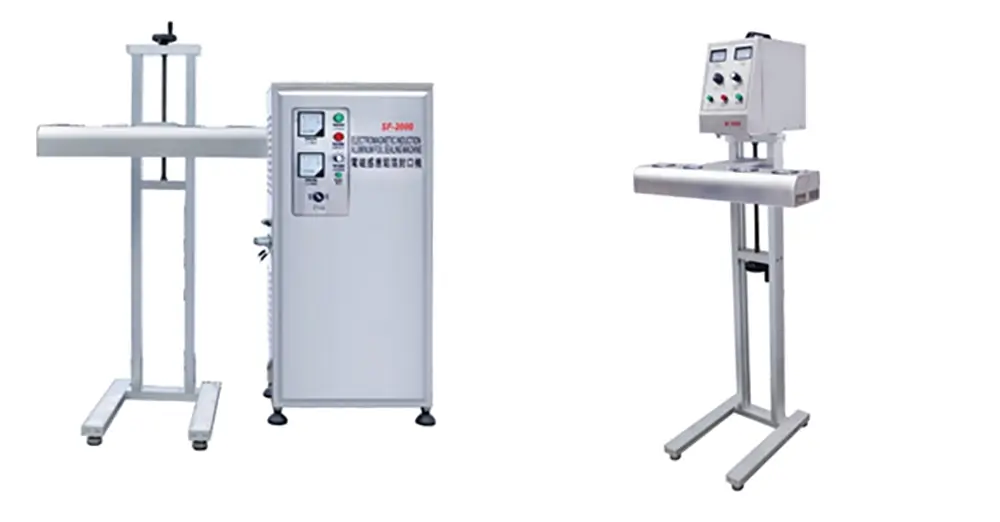
| Model | SF-2000 | Model | SF-2600 |
| Power supply | AC220V 50/60Hz 3500W | Power supply | AC220V 50/60Hz 3500W |
| Bottle diameter | Ø15~60mm | Bottle diameter | Ø15~60mm |
| Cooling method | Air-cooler | Cooling method | Air cooler |
| Main unit dimension | 502×320×1113mm | Main unit dimension | 685×610×1388mm |
| Conveying speed | 0~12.5±0.5 meter/min | Conveying speed | 0~12.5±0.5 meter/min |
Other, more economical models
SF1300 /SF1800 desktop aluminum foil induction sealing machine

| Model | SF-1300 |
| Applicable bottle diameter | 13-60mm |
| Bottle height | 20-180mm |

| Model | SF-1800 |
| Applicable bottle diameter | 50-120mm |
| Bottle height | 20-240mm |
SF PORTABLE aluminum foil induction sealing machine


Tips: For irregular-shaped bottles where the highest point of the bottle body is some distance away from the cap, we generally recommend customers use a tunnel-style induction sealer head — see image below. This custom induction sealer ensures

Why choose XUEFILL?
With over 25 years of experience in the packaging industry, Xuefill is your trusted partner for induction sealing and filling solutions. As a professional manufacturer, we own a 4,000+ square meter R&D and production base, integrating R&D, design, production, and sales into one strong manufacturing entity.
To date, Xuefill has been granted more than 100 invention patents, utility model patents, design patents, and various certifications. We were also invited to participate in the development of a national standard for packaging machinery safety requirements. Our high-precision micro-dosing filling machine series has won multiple honors, including the National Science and Technology Achievement Award, and our company is recognized as one of the Top 100 liquid filling equipment manufacturers in the industry.
When you need a reliable induction sealer for your production line, Xuefill delivers. We are committed to providing efficient, stable, and high-quality sealing results and complete packaging solutions. To learn more about Xuefill induction sealers or related sealing technology, please contact us or send an email to: info@xuefill.com.