Introduction
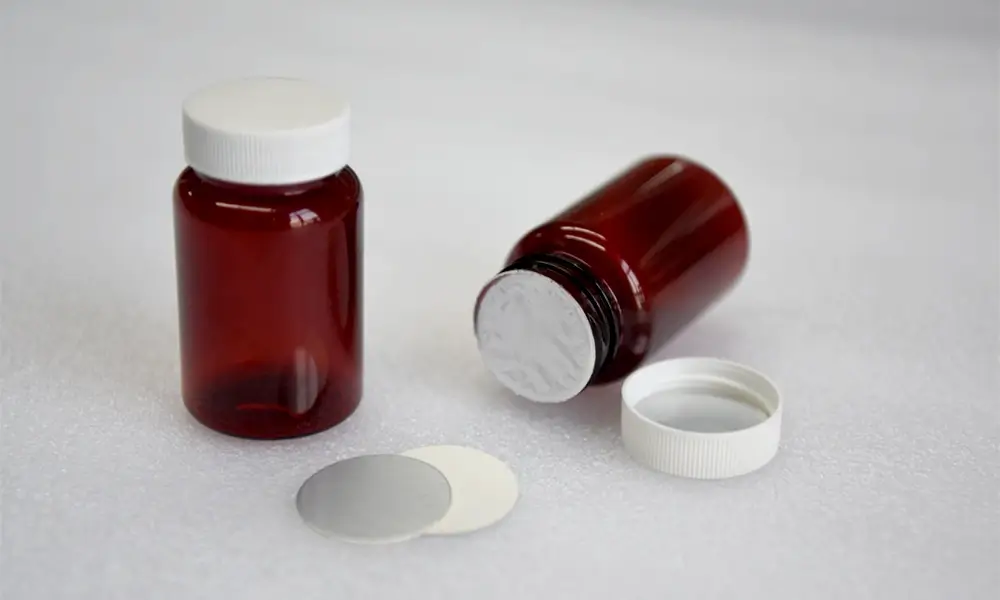
Have you ever opened a bottle and noticed a thin layer of foil or plastic under the cap that needs to be peeled off?
This is called induction sealing—a common yet essential packaging technology widely used in everyday products, from toothpaste, cosmetics, and sauces to pharmaceuticals, typically applied using an induction sealer.
Although it may seem simple, induction sealing plays a vital role in protecting product quality, preventing leakage, and ensuring safety.
So, what exactly is induction sealing, and how does an induction sealer work? What is its purpose? In this article, we will explain everything step by step.
What Is Induction Sealing?
Induction sealing is a non-contact sealing process that uses high-frequency electromagnetic induction to heat and bond a foil liner to the container opening.
This process is carried out by an induction sealing machine (also known as an induction sealer machine or induction seal machine). Its core function is to rapidly heat the aluminum foil liner inside the cap and fuse it onto the container, creating an airtight seal that prevents leakage, tampering, and contamination.
To fully understand how induction sealing works, it is essential to first understand one of its key components—the foil liner.

What Is an Induction Seal Liner?
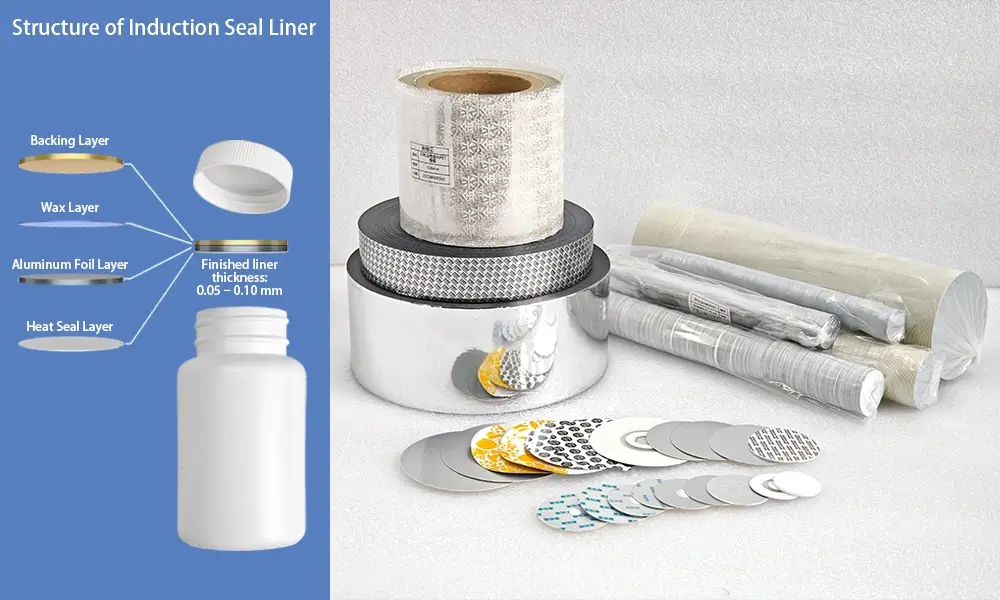
An induction seal liner (also known as an induction seal liner or induction seal) is a specialized sealing material used with an induction sealer. It is typically placed inside the cap before sealing and bonds tightly to the container opening afterward.
Its functions include leak prevention, tamper evidence, freshness preservation, and product protection.
It is not a simple piece of paper but a multi-layer composite structure.
Typical Structure (from top to bottom)
1. Backing Layer (Paper or Plastic)
Provides structural support and remains inside the cap after sealing without bonding to the container.
2. Wax Layer
Acts as a separation layer. When heated, it melts and allows the backing layer to separate from the foil.
3. Aluminum Foil Layer
This is the core heating layer in induction sealing. Under the electromagnetic field of an induction sealer, the foil generates eddy currents and heats up rapidly.
4. Heat Seal Layer
Melts and bonds firmly to the container opening, forming a secure seal.
After Sealing
After sealing is completed:
- The foil remains bonded to the container opening
- The backing layer stays inside the cap
Tips: Based on our industry experience, many users often overlook a key detail when selecting liners: the material of the aluminum foil liner must be compatible with the container material (typically marked at the bottom, such as PE, PP, PS, PVC, etc.). Only then can optimal sealing performance be achieved.
Working Principle of Induction Sealer
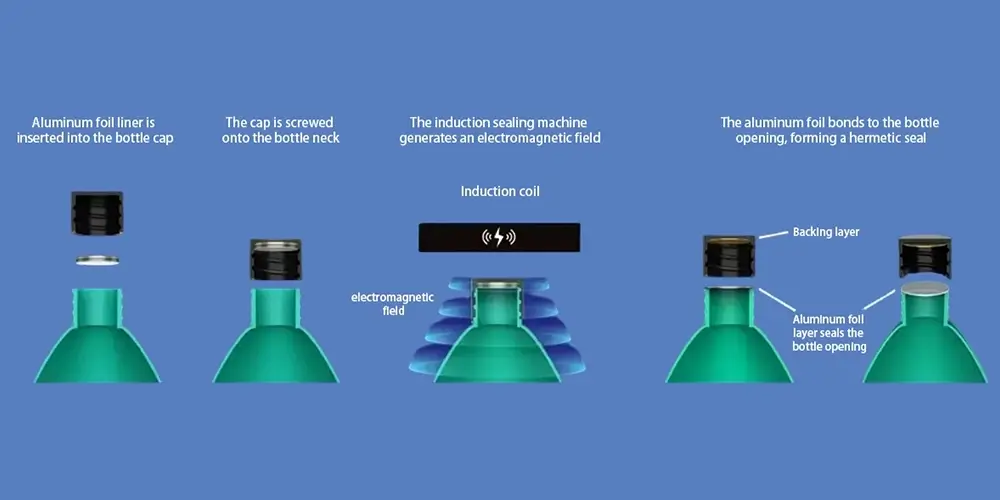
- When the induction sealer is turned on, it generates a high-frequency electromagnetic field through an induction coil.
- As containers with liners pass through, the aluminum foil produces eddy currents and heats up rapidly—without contact or open flame.
- The heat melts the sealing layer, bonding it tightly to the container opening.
- After cooling, the foil forms a strong seal. The entire induction sealing process is non-contact and efficient.
Functions and Applications of Induction Sealing
Main Functions:
- Leak Prevention
Forms a complete airtight seal on the container opening using an induction sealer, preventing liquids, creams, and powders from leaking during transportation and storage. - Tamper Evidence
After induction sealing, the foil must be broken to open the container, making it easy to identify whether the product has been opened and ensuring product safety. - Moisture Protection, Freshness, and Shelf Life Extension
The aluminum foil used in induction sealing effectively blocks air, moisture, and light, preventing oxidation, dampness, and spoilage, thereby helping extend the product’s shelf life. - Prevention of Evaporation and Contamination
Induction sealing reduces the loss of volatile substances such as chemicals, fragrances, and essential oils, while also preventing external dust and bacteria from entering.
Applications of Induction Sealing
Induction sealing is widely used in daily life and is closely related to many industries. The induction sealer plays a key role in ensuring product safety and packaging quality.
Common application areas include:
- Pharmaceutical Industry
Such as medicine bottles, oral liquids, capsule containers, and ointment jars, where induction sealing is a standard packaging method. - Food Industry
Including products like mayonnaise, ketchup, salad dressing, honey, chili sauce, cooking oil, beverages, health supplements, and milk powder cans—all commonly sealed using an induction sealer. - Cosmetics and Personal Care
Common products include shampoo, body wash, creams, serums, essential oils, and toothpaste, where induction sealing helps maintain product integrity. - Chemical and Agricultural Industry
Such as engine oil, lubricants, pesticides, fertilizers, cleaning agents, and solvents, where an induction sealer ensures leak-proof and safe packaging. - Other Applications
Including pet food, automotive supplies, adhesives, and stationery products that require induction sealing for preservation and protection.
However, induction sealing is not the only sealing method available. So how does it compare to traditional heat sealing?
Induction Sealer vs Heat Sealer
| Comparison Projects | Induction Sealer | Heat Sealer |
| Sealing Method | Non-contact sealing that uses an electromagnetic field to heat the foil liner; only the aluminum layer is heated. | Contact sealing where heated elements directly press and seal materials through high temperature. |
| Heating Target | Foil liner inside bottle caps (specifically designed for container sealing). | Plastic bags, laminated films, aluminum-plastic packaging, cup lids, and other flexible materials. |
| Sealing Effect | Provides airtight sealing with strong moisture-proof, leak-proof, and tamper-evident performance; cannot be resealed once opened. | Moderate sealing reliability; prone to leakage and air gaps; no tamper-evident function. |
| Impact on Container | No direct contact with the container; does not deform plastic or glass bottles; does not heat the contents. | Direct high-temperature contact; may deform plastic containers; not suitable for bottle sealing. |
| Applications | Widely used in food, pharmaceuticals, cosmetics, oils, and health products that require high safety and hygiene standards. | Commonly used for snack bags, beverage cups, seasoning pouches, and other flexible packaging. |
| Ease of Operation | Moderate operation difficulty; requires basic setup (matching container size and adjusting power), but easy to learn. | Very easy to operate; no training required—simply place and press to seal. |
| Main Advantages | High efficiency and stability; supports automated production lines; meets food and pharmaceutical safety standards. | Cost-effective, flexible, and portable; suitable for small workshops or home use. |
| Main Disadvantages | Higher equipment cost; requires specialized induction seal liners; only suitable for bottle sealing. | No tamper-proof function; lower sealing stability; prone to leakage; may damage containers. |
| Consumable Cost | Higher (requires dedicated induction seal liners). | Very low (no special consumables required). |
| Production Efficiency | High-speed operation; compatible with automated lines (0–280 bottles/min); suitable for industrial production. | Medium to low speed; mostly manual or semi-automatic; suitable for small-scale use. |
| Safety | No open flame and no direct contact; compliant with GMP safety standards. | High-temperature contact; risk of burns and packaging damage. |

Given its many advantages and wide range of applications, one question naturally arises—how much does an induction sealing machine actually cost?
Pricing and Applications of Different Types of Induction Sealing Machines
| Types | Price Range | Factors | Application |
| Handheld induction sealer | typically ranges from $250 to $2,000, | depending on sealing diameter, power, and customization requirements | suitable for home use and small workshops |
| Tabletop / semi-automatic machines | generally range from $2,000 to $11,000 | depends on the power, sealing diameter, sealing speed, and customization requirements | ideal for small to medium-scale production |
| Economical/automatic induction sealing machine | usually ranges from $2,500 to $12,000 | depends on the power, sealing diameter, sealing speed, and customization requirements | suitable for cost-effective production solutions |
| Air-cooled automatic induction sealing machine | Typically, it ranges from $5,000 to $25,000 | depends on the cooling method, power, sealing diameter, sealing speed, and customization requirements | widely used in food, pharmaceutical, cosmetic, and chemical production lines |
| Water-cooled high-speed machines | generally range from $8,000 to $29,000 | depends on the cooling method, power, sealing diameter, sealing speed, and customization requirements | designed for large-scale, high-speed industrial production |
Tips: Browse Xuefill’s full range of induction sealing machines to choose the most suitable model, or contact us for personalized recommendations and a competitive quote.

Based on different production needs and budgets, choosing the right machine becomes critical. Here is a reliable solution worth considering.
High-Efficiency Air-Cooled Automatic Induction Sealing Machine
Xuefill’s high-efficiency, eco-friendly, and energy-saving air-cooled automatic electromagnetic induction sealing system is a core packaging equipment built on over 20 years of industry expertise. Founded in 2000, Xuefill is one of China’s earliest original manufacturers focusing on the R&D, design, and production of induction sealing machines, with induction sealing technology as its core strength ever since. Through continuous technological innovation and process optimization, Xuefill holds more than a hundred invention patents, utility model patents, and design patents. Many products have obtained authoritative certifications, and their strength is not only recognized by the market but also makes them a preferred choice for many peers in direct procurement and export.
As one of Xuefill’s flagship products, the SF-2300 induction sealing machine fully inherits the brand’s core advantages and is designed to meet the demanding requirements of high-output production lines. The sealing speed can reach up to 0–280 bottles per minute, and it can be seamlessly integrated into packaging and filling production lines, making it ideal for large-scale continuous production.
In terms of performance and environmental efficiency, this induction sealer adopts an energy-saving air-cooling system. It eliminates the need for complex water-cooling setups while achieving stable cooling performance comparable to water-cooled machines.
At the same time, it is equipped with automatic protection functions, including water shortage protection, overcurrent protection, and overvoltage protection, ensuring safe and stable operation while reducing energy consumption and operational risks.
The machine body is made of 304 stainless steel, making it durable and compliant with hygiene standards in the food and pharmaceutical industries. The operation is user-friendly, featuring knob adjustment, button controls, and handwheel height adjustment, allowing even beginners to quickly learn how to operate the induction sealer.
From a green design perspective, Xuefill focuses on reducing material usage and improving efficiency. This induction sealing machine optimizes internal component configuration, reduces machine size, and lowers overall weight. These improvements help reduce manufacturing costs, minimize maintenance expenses, and lower energy consumption during operation. As a result, it achieves both high efficiency and environmental sustainability.
This air-cooled induction sealing machine is highly versatile and suitable for a wide range of industries, including medical, cosmetic, food, and chemical sectors. It can easily handle different container shapes, such as round bottles, square bottles, and irregular containers, providing a comprehensive sealing solution for various packaging needs.
Why Choose Xuefill Induction Sealer
Xuefill has more than 25 years of experience in the packaging industry and is a reliable partner for induction sealing and filling solutions.
As a professional manufacturer, the company operates a 4,000+ square meter production facility integrating research and development, design, manufacturing, and sales.
Currently, Xuefill holds over 100 patents and certifications, including invention patents, utility models, and design patents. The company has also participated in the development of national standards for packaging machinery safety. Its high-precision filling machine series has received multiple national science and technology awards, making it one of the top enterprises in the liquid packaging equipment industry.
Xuefill is committed to providing high-quality, efficient, and reliable induction sealing machine solutions.
If you would like to learn more about induction sealing processes or equipment, feel free to contact us or send an email to:
info@xuefill.com / WhatsApp:+86 18028686502.