Introducción
Every day, millions of people use products that contain a flammable liquid without giving them a second thought. Whether it’s spraying perfume before work, disinfecting a wound with rubbing alcohol, filling a car with gasoline, or removing nail polish with acetone, these activities have become so routine that we often forget they involve substances capable of catching fire under the right conditions.
Fortunately, most of these products are perfectly safe when used correctly. The real danger doesn’t come from the liquid itself—it comes from a lack of awareness. Improper storage, poor ventilation, open flames, electrical sparks, and even static electricity can quickly turn an ordinary household product into a serious fire hazard.
While home accidents are relatively uncommon, the risks become significantly greater in places where large volumes of flammable liquids are stored, transferred, or filled every day. Understanding why these liquids ignite and how to minimize potential hazards is the first step toward protecting your family, your property, and your workplace.
This guide explains what a flammable liquid is, introduces common examples of flammable liquids found in everyday life, explores the science behind their behavior, and shares practical tips for handling them safely. We’ll also look at why industrial filling operations require much stricter safety standards and how explosion-proof pneumatic technology helps reduce risks.
What Makes a Flammable Liquid Dangerous?
Before learning how to handle a flammable liquid, it’s important to understand why these substances can become dangerous.
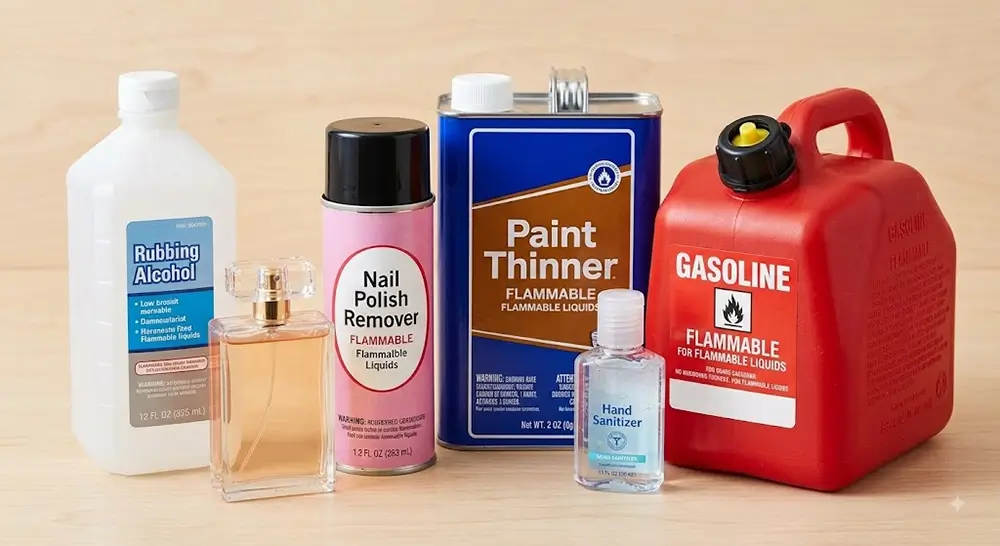
A flammable liquid is generally defined as a liquid that gives off enough vapor to ignite at relatively low temperatures. Contrary to what many people believe, it is usually the vapor—not the liquid itself—that burns. When the vapor mixes with oxygen in the air and encounters an ignition source, combustion occurs almost instantly.
This is why you may notice a warning label on products that appear harmless. Even a small bottle of perfume or a container of rubbing alcohol can produce invisible vapors capable of igniting if they are exposed to sparks, cigarettes, candles, or electrical equipment.
Flash Point: The Key Concept Behind Flammability
One of the most important concepts in the flammable liquid definition is the flash point.
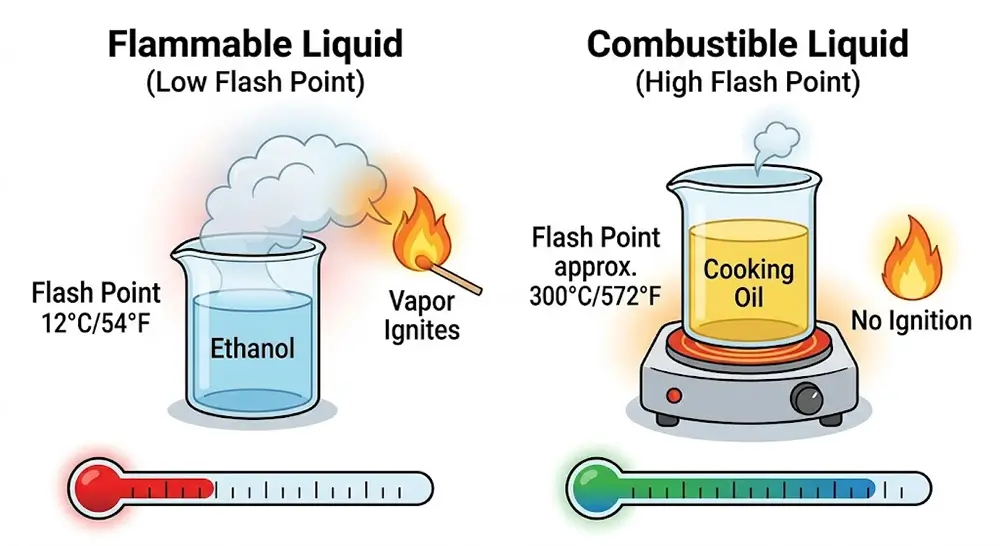
The flash point is the lowest temperature at which a liquid releases enough vapor to ignite when an ignition source is present. Generally speaking, the lower the flash point, the easier it is for a liquid to catch fire.
Por ejemplo:
- Gasoline has an extremely low flash point, allowing it to produce flammable vapors even in cold weather.
- Ethanol, commonly found in disinfectants and perfumes, also has a relatively low flash point, making it highly flammable.
- Cooking oils, on the other hand, usually have much higher flash points and require significantly higher temperatures before they become dangerous.
Understanding the relationship between flash point and vapor formation helps explain why some liquids ignite much more easily than others.
Flammable Liquid vs. Combustible Liquid
Many people also confuse a flammable liquid with a combustible liquid, but they are not the same.
Although both can burn, a combustible liquid generally has a higher flash point and therefore requires more heat before it begins releasing enough vapor to ignite. This distinction is widely used in industrial safety standards because different storage and handling requirements often apply to each category.
Knowing the difference between a flammable liquid and a combustible liquid is especially important for businesses that manufacture, transport, or store chemicals, fuels, coatings, and solvents.
Is Flammability a Physical or Chemical Property?
Another common question is whether flammability is a physical or chemical property.
From a scientific perspective, flammability is considered a chemical property because it describes how a substance reacts chemically with oxygen during combustion. However, understanding this concept isn’t just useful in chemistry classrooms—it helps explain why certain liquids require stricter safety procedures than others.
Common Flammable Household Liquids You May Be Using Every Day
When people hear the words “flammable liquid,” they often imagine oil refineries, chemical plants, or industrial warehouses. In reality, many flammable household liquids are probably already sitting somewhere in your home.
The biggest problem is familiarity. Because these products are used so often, most people stop recognizing them as potential hazards.
Below are some of the most common examples of flammable liquids found in everyday life.
Alcohol
Alcohol is perhaps the best-known example of a flammable liquid. Medical alcohol, industrial ethanol, and isopropyl alcohol are widely used for cleaning, disinfecting, and manufacturing.
Because alcohol evaporates quickly, it produces highly flammable vapors that can ignite if exposed to open flames or electrical sparks before the liquid has completely dried.
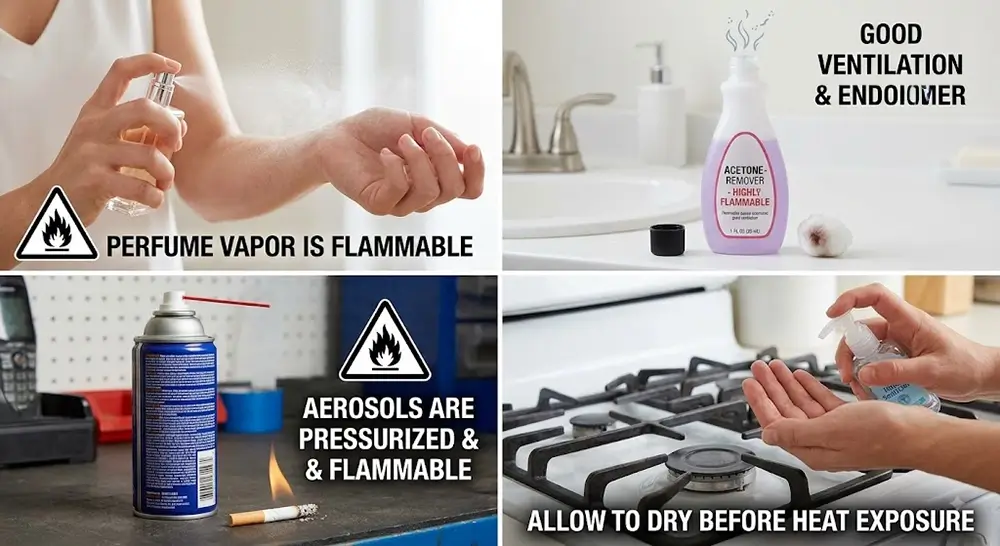
This is why health professionals recommend allowing alcohol-based disinfectants to dry naturally before approaching any heat source.
Desinfectante de manos
During the COVID-19 pandemic, hand sanitizer became a household necessity around the world.
Most alcohol-based sanitizers contain between 60% and 80% alcohol, making them highly flammable before evaporation is complete.
Although accidents are rare, using hand sanitizer near candles, gas stoves, or welding equipment can increase the risk of ignition.
Perfume
Many people are surprised to learn that perfume is also considered a flammable liquid.
The pleasant fragrance comes from essential oils dissolved in alcohol. Since the alcohol evaporates almost immediately after spraying, a cloud of flammable vapor is briefly released into the surrounding air.
For this reason, perfume should never be sprayed near open flames, cigarettes, or high-temperature appliances.
Nail Polish Remover
Most nail polish removers contain acetone, an organic solvent with a very low flash point.
Besides being highly flammable, acetone evaporates extremely quickly, allowing vapors to spread across nearby surfaces. Good ventilation is therefore essential whenever acetone-based products are used indoors.
Gasolina
Gasoline remains one of the most dangerous flammable liquids used by consumers.
Unlike many household products, gasoline produces large volumes of vapor even at relatively low temperatures. These vapors are heavier than air and can travel several meters before reaching an ignition source.
This explains why a spark located far away from a fuel container can still trigger a fire.
Paint Thinners and Cleaning Solvents
Many paint thinners, degreasers, and industrial cleaning products contain petroleum-based solvents.
Although they are extremely useful for maintenance work, they should always be stored in tightly sealed containers away from direct sunlight and heat sources.
Aerosol Sprays
Air fresheners, spray paints, lubricants, and insect sprays often contain pressurized propellants that are highly flammable.
Even an empty aerosol can may still contain enough propellant to create a fire hazard if exposed to excessive heat.
Looking at this list, it’s easy to see that flammable liquids are not unusual industrial chemicals—they are products many families use every single day. The key to reducing risk is not avoiding these products entirely, but understanding how they behave and respecting their safety instructions.
How to Safely Store and Handle Flammable Liquids at Home
Knowing which products are flammable is only the first step. Practicing proper safety habits is what truly reduces the likelihood of accidents.
One of the simplest but most effective precautions is to store flammable liquids in their original, tightly sealed containers. Transferring chemicals into beverage bottles or unmarked containers can create confusion and significantly increase the risk of misuse.
Location also matters. Flammable liquids should always be kept away from direct sunlight, radiators, heaters, and any equipment capable of generating heat. A cool, dry, and well-ventilated storage area is usually the safest choice.
For homeowners who keep larger quantities of fuels, paints, or solvents, investing in a flammable liquid storage cabinet can provide an additional layer of protection. These cabinets are specifically designed to reduce fire spread and safely isolate hazardous materials.
Good ventilation is another essential safety practice. Since many flammable liquids release invisible vapors, using them in enclosed spaces allows vapor concentrations to build up. Opening windows or using appropriate ventilation systems helps disperse these vapors before they reach dangerous levels.
Pay Attention to Static Electricity
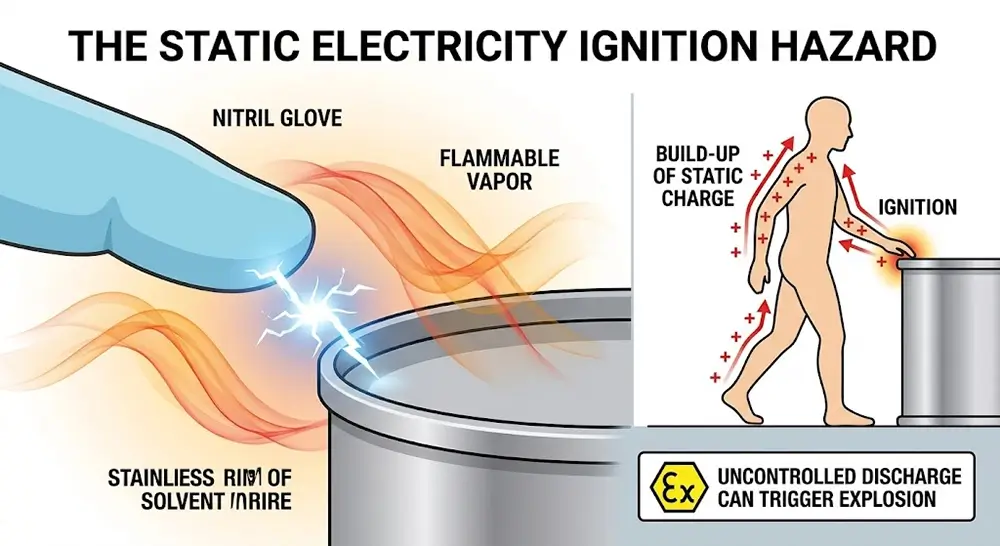
One hazard that many people overlook is static electricity. Simply walking across certain floor surfaces, removing synthetic clothing, or handling plastic containers can generate static charges. Under the wrong conditions, a static discharge may produce a tiny spark—often too small to notice but still capable of igniting flammable vapors.
For this reason, professionals handling flammable liquids often use grounding and bonding techniques to safely dissipate static electricity before transferring liquids between containers.
Learn to Recognize Warning Labels
Another useful habit is learning to recognize warning labels. Modern chemical containers usually display an explosive hazard symbol or other internationally recognized safety pictograms. These signs provide valuable information about the risks associated with a product and should never be ignored.
Many accidents occur not because the products are unusually dangerous, but because warning labels are overlooked or safety instructions are ignored. Developing basic awareness of these symbols is one of the easiest ways to improve personal and workplace safety.
Why Flammable Liquids Become More Dangerous During Industrial Filling
For most households, the amount of flammable liquid used each day is relatively small. A bottle of perfume, a can of paint thinner, or a container of rubbing alcohol may present a potential fire hazard, but when these products are handled properly, the overall risk remains low.
Industrial production is completely different.
Manufacturers in the pharmaceutical, cosmetics, chemical, food, and petroleum industries often process hundreds or even thousands of liters of flammable liquids every day. During storage, mixing, transferring, and especially filling operations, these liquids continuously release vapors into the surrounding environment.
Unlike home use, industrial production combines three critical conditions at the same time:
- Large quantities of flammable liquids
- Continuous vapor generation
- Multiple potential ignition sources
When these factors exist together, the possibility of a fire increases dramatically. More importantly, if vapors accumulate in confined spaces and mix with air within a specific concentration range, what begins as a simple ignition can quickly develop into an explosion.
This is why industrial facilities focus not only on preventing fires but also on preventing explosions.

How Fire Turns Into an Explosion
Many people use the words fire and explosion interchangeably, but they are not the same.
A fire usually occurs when a combustible material is ignited and burns in an open environment. An explosion, however, happens when flammable vapors rapidly ignite inside a confined or partially enclosed space, causing pressure to increase almost instantly.
This pressure wave is often responsible for far greater damage than the flames themselves.
For an explosion to occur, three elements generally need to be present:
- Fuel – the flammable liquid and its vapor.
- Oxygen – supplied by the surrounding air.
- An ignition source – something capable of producing enough energy to ignite the vapor.
Remove any one of these three elements, and the explosion cannot occur.
Unfortunately, eliminating oxygen is impractical in most manufacturing environments. Likewise, many production processes require flammable liquids as essential raw materials.
As a result, modern industrial safety focuses on controlling the third element—the ignition source.
This approach explains why explosion-proof equipment has become a standard requirement in many industries.
Common Ignition Sources During Filling Operations
Many people assume that open flames are the primary cause of industrial fires. In reality, most ignition sources are much less obvious.
One of the most common hazards is static electricity.
Whenever liquid flows through pipes, hoses, pumps, or filling nozzles, friction naturally occurs. Under certain conditions, this movement allows electrical charges to accumulate. If the charge suddenly discharges, even a tiny spark can ignite flammable vapors.
Although the spark may be almost invisible, it can provide enough energy to trigger combustion.
Electrical equipment is another significant concern.
Before choosing equipment for hazardous liquids, it helps to understand the main liquid filling machine types and how different drive systems affect safety and performance. While these systems are perfectly suitable for many ordinary liquids, they require additional protection when handling flammable solvents, alcohols, fuels, or volatile chemicals.
Mechanical friction can also contribute to risk. Bearings, rotating shafts, worn components, or improperly maintained equipment may generate localized heat during continuous operation.
Individually, these hazards may seem insignificant.
However, when combined with high concentrations of flammable vapor, they create conditions where even the smallest ignition source may lead to catastrophic consequences.
This is why industries handling alcohol, ethanol, perfumes, essential oils, paints, coatings, solvents, and petroleum products place such a strong emphasis on explosion prevention rather than simply fire prevention.
A Safer Approach: Why Pneumatic Filling Systems Help Reduce Explosion Risks
Once manufacturers understand that ignition sources are one of the most controllable factors in explosion prevention, equipment selection becomes a critical safety decision.
Rather than relying entirely on electrically driven filling systems, many facilities handling flammable liquids choose equipment specifically designed for hazardous environments.
One increasingly common solution is the fully pneumatic filling machine.
Instead of using an electric motor to power the filling mechanism, a pneumatic system operates entirely with compressed air. The movement of the filling components is generated by air pressure, eliminating the need for electrical drive systems within the filling process itself.
This design offers several important safety advantages.
First, because the system contains no electric motor in the operating mechanism, it greatly reduces the possibility of electrical sparks being generated during production.
Second, the pneumatic structure minimizes friction-related ignition sources that may occur in conventional motor-driven equipment.
Third, compressed air provides stable and reliable power without introducing additional electrical heat into hazardous working environments.
For manufacturers processing alcohol, perfumes, essential oils, solvents, coatings, cleaning chemicals, and petroleum-based products, these design characteristics significantly improve operational safety.
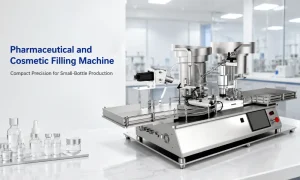
SFQY Semi-Automatic Pneumatic Filling Machine
One example of this approach is the SFQY Semi-Automatic Pneumatic Filling Machine.
Unlike conventional filling equipment that depends on electric motors to perform the filling action, the SFQY system is driven entirely by compressed air. There are no electrical drive components involved in the filling operation, allowing the machine to eliminate potential ignition sources at their origin.
This makes the equipment particularly suitable for applications involving flammable or volatile liquids where explosion prevention is a primary concern.
Of course, even the safest equipment cannot replace proper operating procedures. Effective explosion prevention always depends on a combination of trained personnel, adequate ventilation, correct grounding practices, regular equipment maintenance, and selecting machinery appropriate for hazardous environments.
When these safety measures work together, manufacturers can greatly reduce the likelihood of fires and explosions while improving production efficiency and protecting both employees and valuable assets.

Conclusión
Flammable liquids are an essential part of modern life. They help manufacture medicines, cosmetics, fuels, cleaning products, coatings, and countless everyday items that people rely on around the world.
However, convenience should never lead to complacency.
Understanding concepts such as flash point, recognizing the difference between a flammable liquid and a combustible liquid, identifying common fire hazards, and paying attention to static electricity are all fundamental steps toward reducing risk.
Whether you’re storing household chemicals in a garage or managing large-scale industrial production, the same principle applies: accidents rarely happen because flammable liquids are inherently dangerous—they happen because the hazards surrounding them are underestimated.
For industrial applications, choosing equipment specifically designed for hazardous environments is equally important. By eliminating unnecessary ignition sources through pneumatic technology and following established safety practices, manufacturers can significantly reduce explosion risks while maintaining efficient and reliable production.
Ultimately, safe handling of flammable liquids is not just about complying with regulations—it’s about protecting people, facilities, and the future of every operation that depends on these valuable materials.
If you are filling alcohol, solvents, perfumes, essential oils, or other volatile liquids, you can contact XUEFILL to discuss a suitable pneumatic filling solution.